myRentokil
Manage your business
The "off-season" for pests is over. European infestations rose by nearly 10% between 2023 and 2025 as pests decoupled from traditional seasonal patterns, evidenced by a 28.4% surge in December fly activity. Instead of waiting for winter, rodents are moving into our warm, complex buildings permanently. To protect your business, don’t wait until your next service visit; you need a 24/7 digital defence that monitors the hidden parts of your infrastructure where pests now live year-round.
For centuries, we’ve stayed one step ahead of pests by understanding their seasonal cycles and knowing when to expect them and how to effectively intervene. However, in recent years, these rules have been fundamentally rewritten. Pest seasons as we once knew them no longer seem to exist. Instead, we’re witnessing a year-round surge in activity, with European infestations increasing by nearly 10% in just two years (2023–2025).
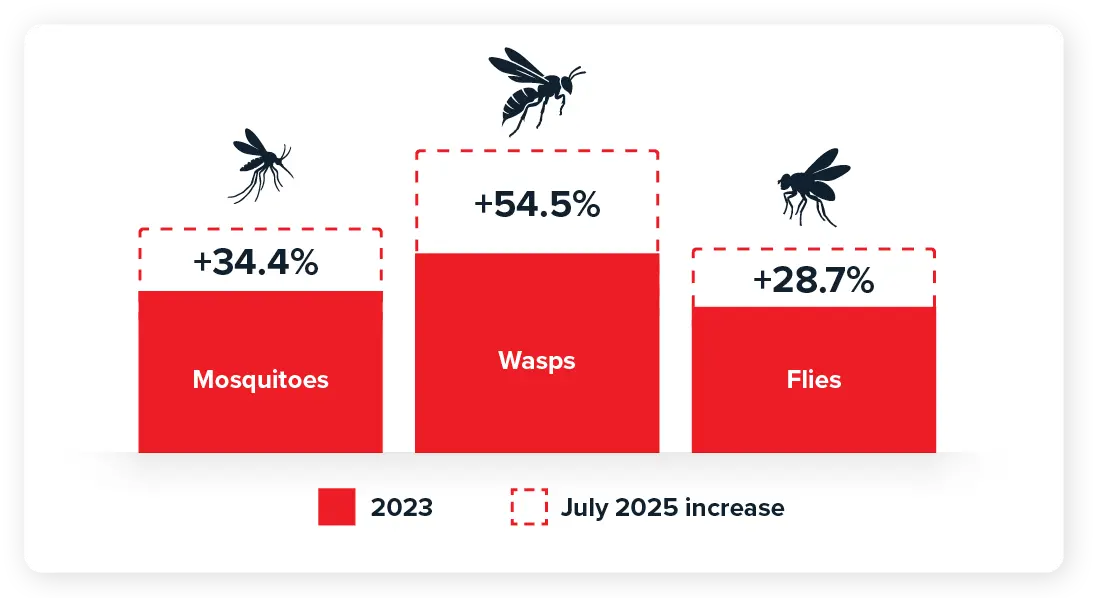
We conducted a deep dive into pest behaviour over the last two years and identified some significant surges, including major spikes in wasp (+54.5%), mosquito (+34.4%), and fly (+28.7%) numbers in July 2025, among many others.
To help you navigate this increasingly erratic landscape, let’s look at the top 5 pest trends European businesses need to prepare for, insights from our Senior Industry Insights Manager, Peter Brooks, and how digital pest control can help you stay ahead.

Across Europe, pest activity is becoming increasingly climate-driven, with rising temperatures, milder winters, and extreme weather events accelerating both growth and unpredictability. Rather than following traditional seasonal cycles, pests are now responding sharply to short-term weather patterns. This is resulting in more volatile, harder-to-manage infestations.
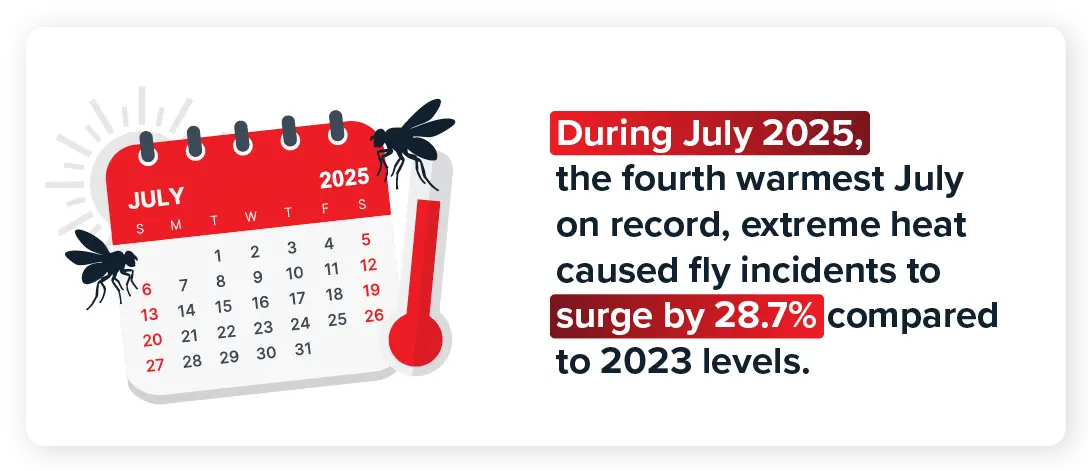
We saw the impact of this volatility clearly in July 2025, the fourth warmest July on record, which triggered dramatic spikes in pest activity:
These aren't just mid-summer peaks; pests are also emerging much earlier than they used to. For instance, by April 2025, activity across several pest categories had already jumped by up to 31%, meaning the busy season is starting weeks earlier than businesses are used to.
Peter Brooks (Senior Industry Insights Manager) explains the data: "What's most striking in the numbers isn't just the height of the summer peaks, but the volatility. We're seeing 'flash infestations' triggered by short-term weather events. For a business, this means a stable environment can become a high-risk zone in less than 48 hours."
It’s not just the heat, either. The record rainfall in 2024 left behind ideal breeding grounds, keeping mosquito numbers high (+34%) well into autumn 2025. At the same time, warmer winters increased overwinter survival across multiple pest types.
Flying insects have become the fastest-growing pest category across Europe, and data shows they’re no longer just a summer nuisance. Driven by extended warm periods and favourable breeding conditions, wasps, flies, and mosquitoes are accelerating faster than any other pest category. We’re seeing a fundamental shift where activity is not just intensifying during the traditional peak months, but is spreading deep into the spring and autumn. This means longer windows of disruption, particularly for outdoor and customer-facing environments.
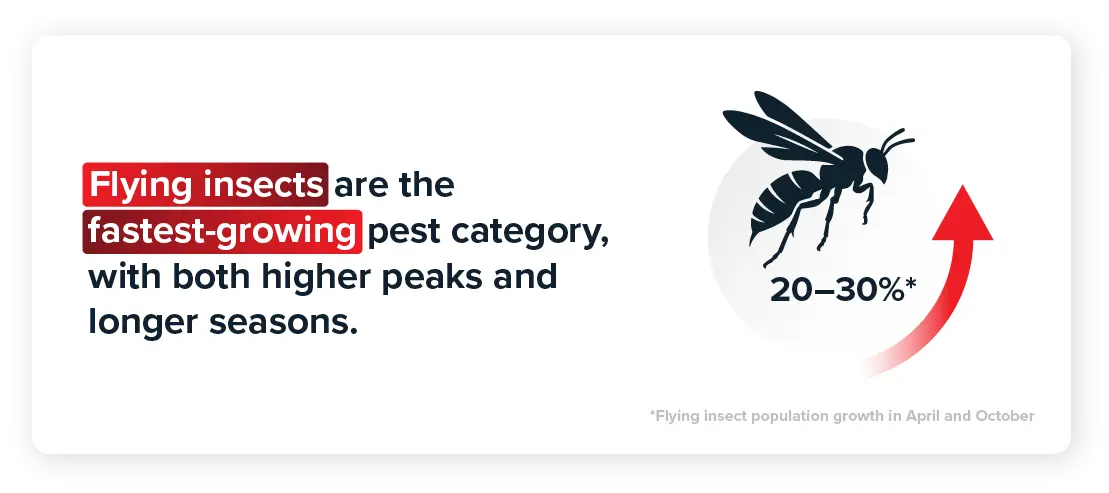
This expansion is most visible in April and October, when flying insect populations have grown by 20–30%.
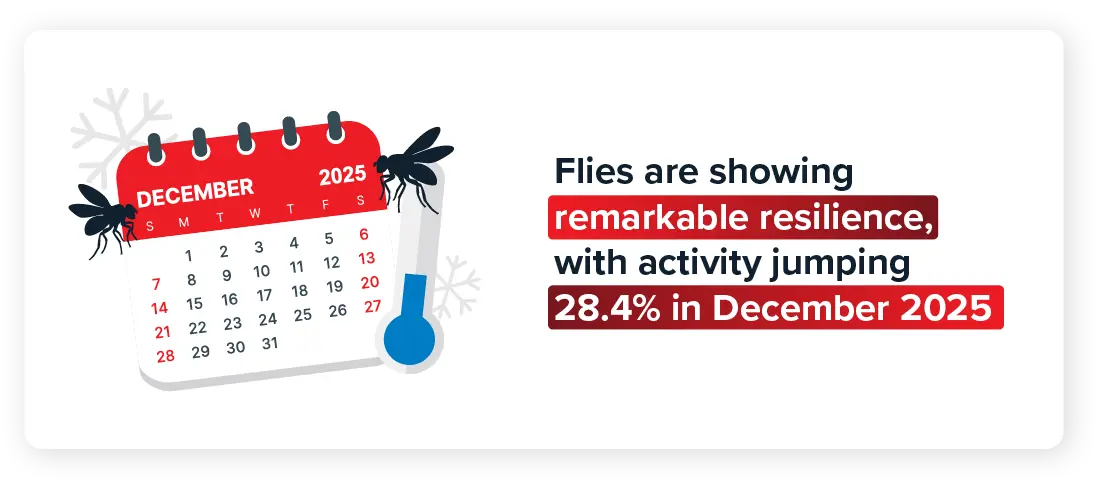
Even the winter months are providing less of a break; flies are showing remarkable resilience, with activity jumping 28.4% in December 2025 and maintaining a stronger baseline through the start of the year compared to 2023.
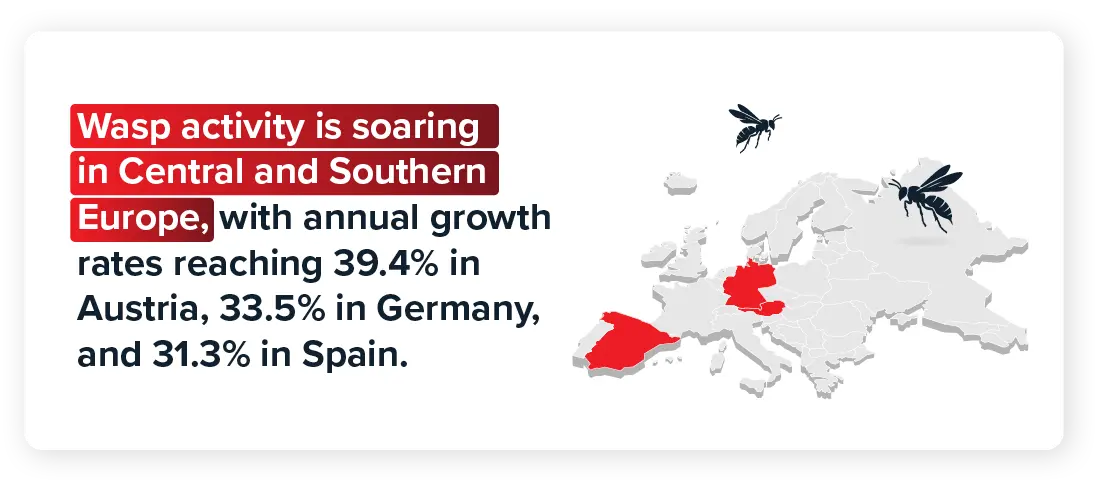
Regionally, the acceleration is even more dramatic. Wasp activity is soaring in Central and Southern Europe, with annual growth rates reaching:
This tells us that the windows of disruption for businesses are staying open much longer, forcing businesses to rethink their pest management strategy.
While rodents remain the most prevalent pest category, we’re seeing a fundamental shift in their behaviour. Previously, businesses expected a sharp peak in autumn as rats and mice migrated indoors to escape the first signs of cold. However, this seasonal pattern is weakening. Driven by urbanisation and milder winters, rodents are now establishing permanent, year-round populations in the infrastructure of our densest cities.
Peter Brooks notes: "The data shows that pests are rapidly adapting to our shifting environment. Milder autumns and shorter, warmer winters have extended breeding cycles and significantly increased winter survival rates. For businesses, this means pests aren't just visiting facilities to survive the cold — they’re leveraging these 'milder' conditions to become permanent, year-round residents of the infrastructure itself."
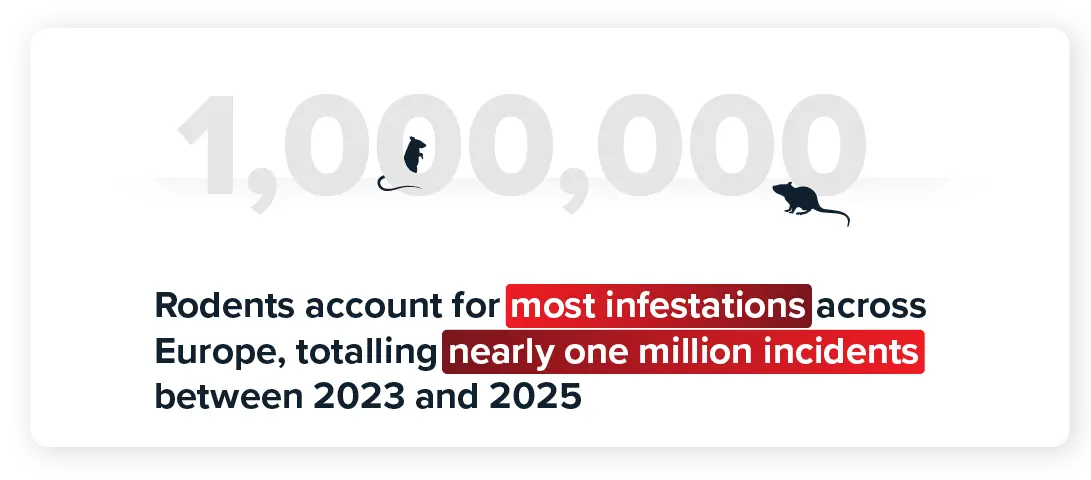
The scale of this shift is significant, with mice and rats now accounting for most infestations across Europe, totalling nearly one million incidents between 2023 and 2025. During this period, mouse infestations grew by 8.7% while rats increased by 6.4%, but it’s the timing of this activity that has changed most.
Traditional autumn migration peaks are actually fading (down roughly 4% in late 2025) because rodents are no longer waiting for the cold weather and diminishing food sources to move in, they’re already there. In hotspots like the Netherlands and Spain, these populations are growing particularly fast, with annual growth rates approaching 15%. Essentially, rodents have moved from being seasonal visitors to permanent residents.
Climate change is driving shifts in pest patterns outdoors, but there’s an even more pressing challenge indoors: the permanent indoor habitat.
Complex, busy buildings, such as hospitals and labs, that are kept warm year-round and feature intricate designs full of hidden pipes and vents, provide pests with a 365-day-a-year breeding ground.
This is a huge problem for businesses with stringent hygiene requirements, where even minor infestations can cause significant operational disruption.
Cockroaches are among the pests that take advantage of the climate-controlled environments, with activity surging by 15% annually in government, education, and healthcare facilities. The pharmaceutical and scientific sectors are following closely behind with a 14.8% yearly increase.
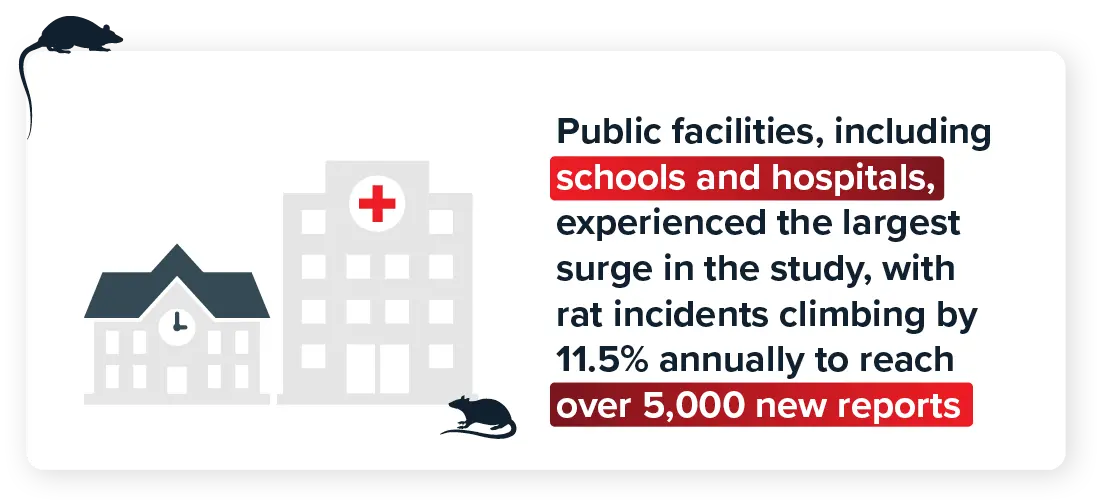
But the largest absolute growth we saw? Rats in public facilities (such as government, education, and healthcare buildings), where we saw over 5,000 new rat incident reports, with an annual increase of 11.5%.
The Government, Education, and Health sector has become a primary target for a wide variety of pests, appearing in six different high-growth categories. This reflects the immense challenge of managing large, high-occupancy estates where aging infrastructure and complex layouts provide multiple entry points for diverse pest species to thrive simultaneously.
In densely populated areas, urban heat and crowded infrastructure are creating the perfect conditions for pests to thrive indoors. Complex plumbing and waste systems in high-density cities are now acting as primary drivers for year-round infestations. A prime example is Spain, which saw a massive surge of 27,000 cockroach incidents.
These pests are now effectively "decoupled" from the seasons, meaning they no longer rely on outdoor weather cycles to survive or breed. By moving into the constant heat and humidity of modern internal infrastructure, they can ignore the winter cold entirely and maintain their populations year-round. To add to the challenge, these populations are developing a genetic resistance to common insecticides, making it harder to eradicate them.
Pest risks are becoming more complex, with multiple pest types impacting the same environments simultaneously.
Different industries are no longer dealing with single pest issues. Instead, they’re up against several different pressures driven by climate, infrastructure, and operational factors. The data shows that high-occupancy, customer-facing sectors, where conditions can support multiple pest types simultaneously, appear to be the most affected.
Let’s take a closer look at the findings by sector.
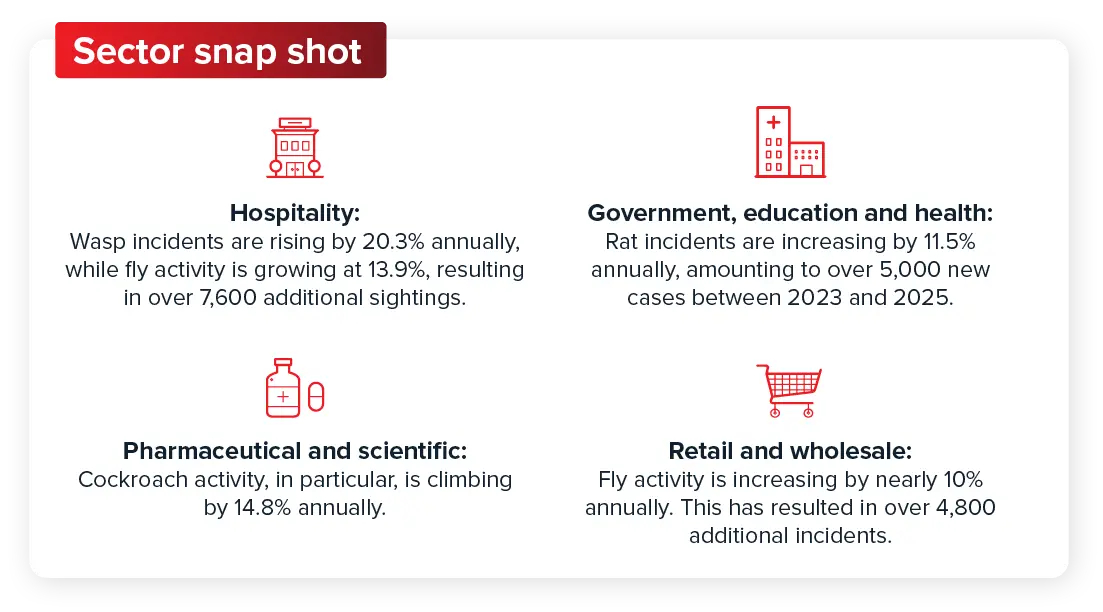
The hospitality sector is facing a significant challenge as flying insects increasingly disrupt guest experiences. Wasp incidents are rising by 20.3% annually, while fly activity is growing at 13.9%, resulting in over 7,600 additional sightings that businesses must now manage to protect their reputations and outdoor dining areas.
Public facilities across these industries are witnessing a steady rise in permanent pest populations, with rat incidents increasing by 11.5% annually, amounting to over 5,000 new cases between 2023 and 2025. At the same time, cockroach activity is surging by 15% each year, as these pests exploit the complex infrastructure and stable internal heat found in hospitals, schools, and government estates.
In the highly regulated Pharmaceutical and Scientific sectors, the risk is becoming increasingly complex as facilities now face pressure from five different pest categories. Cockroach activity, in particular, is climbing by 14.8% annually, as these pests exploit the climate-controlled environments that allow them to thrive year-round.
The Retail and Wholesale sector is seeing a significant rise in hygiene risks, with fly activity increasing by nearly 10% annually. This trend has resulted in over 4,800 additional incidents, underscoring the critical need for businesses to protect their supply chains and stores from these year-round surges.
Across the board, we found that pest numbers appear to be rising rapidly. For example, the data shows 9 distinct pest-sector combinations where activity is surging by at least 10% year-on-year. This highlights that across multiple industries, pest pressure is accelerating quickly.
Peter Brooks highlights the trend: "When you see nine different pest-sector combinations growing at over 10% annually, you're looking at an industrial-scale challenge. This isn't just one type of pest getting lucky; it’s an acceleration of risk across the entire European supply chain, from pharma labs to retail floors."
Infestations are rising by nearly 10% across Europe, rodent infestations totalled nearly one million between 2023 and 2025 alone, and flies are showing remarkable resilience, with activity jumping 28.4% in December 2025. And that’s just a glimpse of some of the significant shifts we’re seeing in the industry.
So what can businesses do to prepare and protect their premises and reputation in this changing landscape?
It’s essential that businesses move from reactive pest control to proactive measures. Adopting a comprehensive integrated pest management (IPM) programme, bolstered by digital pest control, is the best place to start. A robust IPM strategy combines exclusion, restriction, destruction, and monitoring techniques to give you ultimate control and peace of mind.
Digital pest control then takes this to the next level. For example, PestConnect (our digital pest management system) could transform 12 hours of service visits into 8,760 hours of protection. That’s year-round site monitoring to give you the reassurance you need.

Pest control made smarter, faster, and more efficient with the power of technology. It automates trap monitoring and allows for 24/7 protection. It calls on technologies such as IoT (Internet of Things), cloud computing, and — at the cutting edge of this service — AI, to monitor, manage and control pest threats more effectively. For example, machine-learning technology accurately detects rodents or insects captured by connected pest-control cameras and filters out false positives.
Connected pest control helps you stop reacting to infestations and start preventing them. Here’s a breakdown of how it works.
Digital pest control is designed to protect your business without impacting your internet connection. There are many flexible options available where the system operates entirely independently of your company’s Wi-Fi or IT infrastructure. For example, Rentokil’s connected units use a dedicated, industry-standard LoRaWAN® network to ensure smooth operation and minimal disruption.
Similarly, while our environmental monitoring cameras use Wi-Fi for high-speed image sharing, they connect via a secure, standalone router provided by us. This ensures that continuous 24/7 monitoring never causes lag or slowdown on your primary network, keeping your business protected and your connection clear.
Learn how the most established digital pest control system worldwide can keep you one step ahead.
The most established digital pest control system worldwide